Plankton are critical components of the marine ecosystem. There are two groups of plankton, the “phyto” (plant) and “zoo” (animal)-plankton. Both phyto- and zooplankton transfer energy through the food web to larger animals, such as penguins, seals, dolphins and whales. This means it is important we understand how marine plankton respond to future climate change scenarios, as this could have major impact on the whole marine ecosystem. My work concentrates on two components of climate change. The first is the rapid increase in ocean temperature. The second is a process called Ocean Acidification. Increasing levels of carbon dioxide (CO2) in the atmosphere are causing the ocean to become more acidic. These two components, both separately or combined, are proven to be harmful to various marine life.
I study a certain type of zooplanktonic animal called a copepod. Copepods are very small crustaceans, generally less than 2 mm in length. They are the most abundant type of zooplankton in the world’s oceans. My aim is to increase our knowledge of how these tiny, but very important, animals cope under climate change.

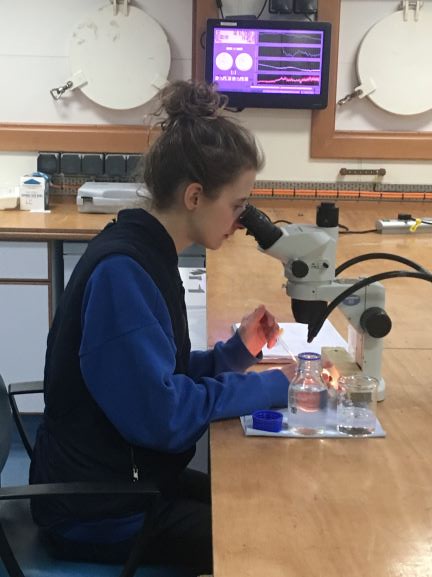
Copepod seen through a microscope… not easy when the floor, desk and everything else are moving in a rough sea!
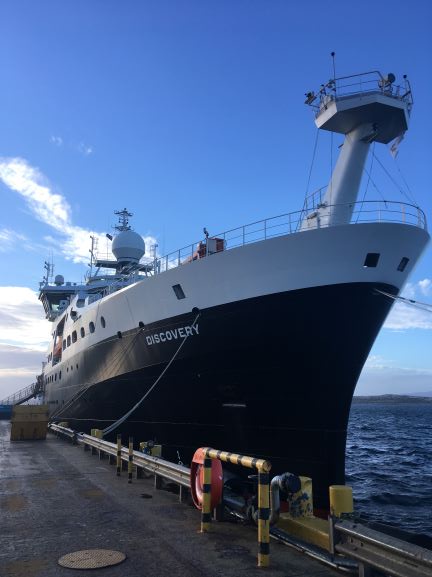
During the Discovery cruise, I am collecting copepods from plankton net hauls. Once caught, they are stored for at least 12 hours in order to acclimatise. I then exposed them to different environmental conditions:
- “normal” – seawater matches natural environment.
- “high temperature” – seawater temperature is increased.
- “acidification” – seawater acidity is increased.
- “high temperature + acidification” – both seawater temperature and acidity are increased.
How copepods, and plankton as a whole, respond to climate change will impact entire marine ecosystems. A better understanding of these responses will increase our ability to predict the future of our oceans.
Louise Cornwall is a Phd Student at Plymouth Marine Laboratory. For more information on her work, email loco@pml.ac.uk



 Adventures in whale counting